Venture pitch
2025InfectiPatch
An investor-style pitch and scientific poster for a microneedle biosensor patch that monitors post-surgical infection through interstitial-fluid biomarkers.
The clinical problem
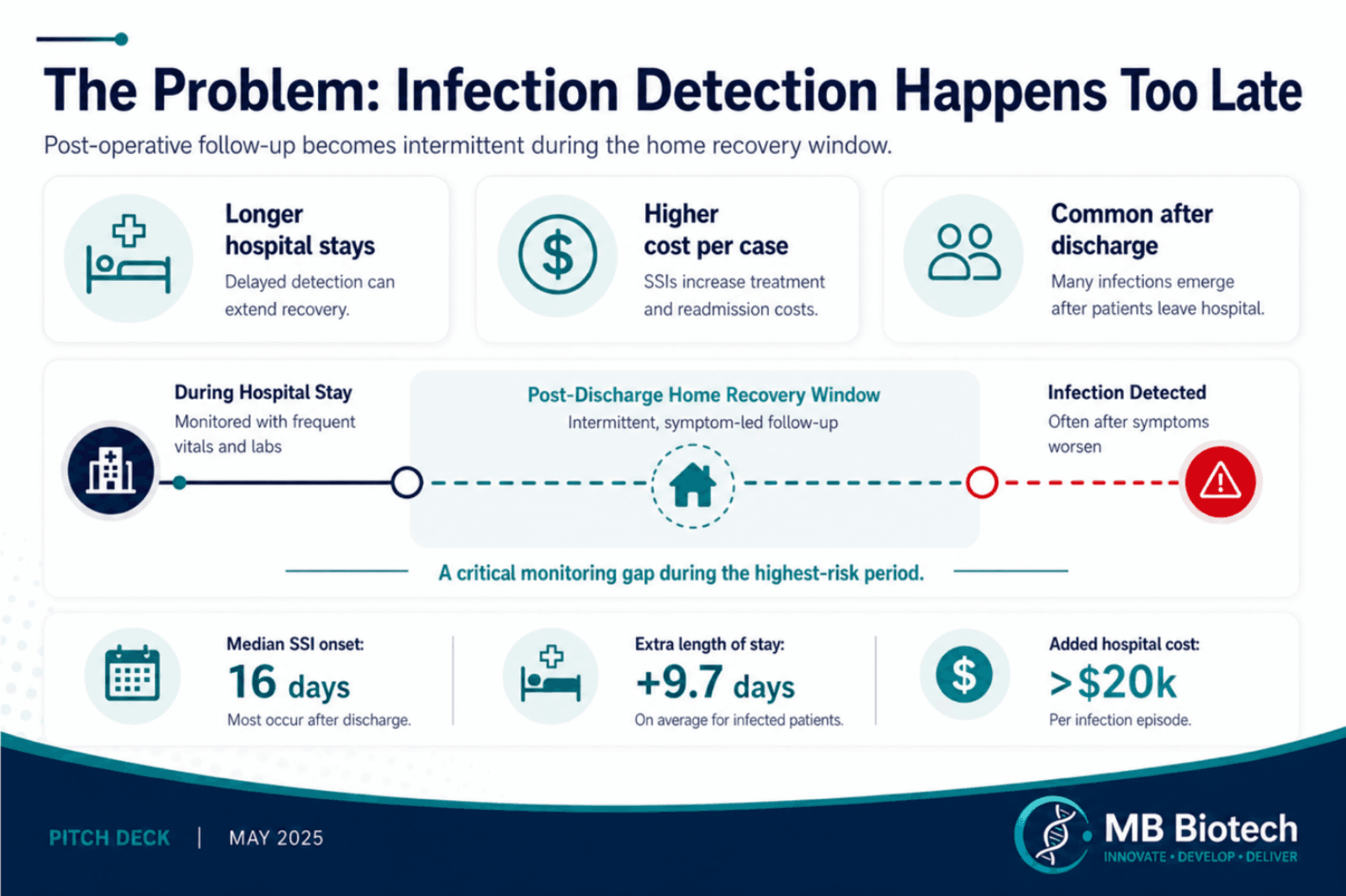
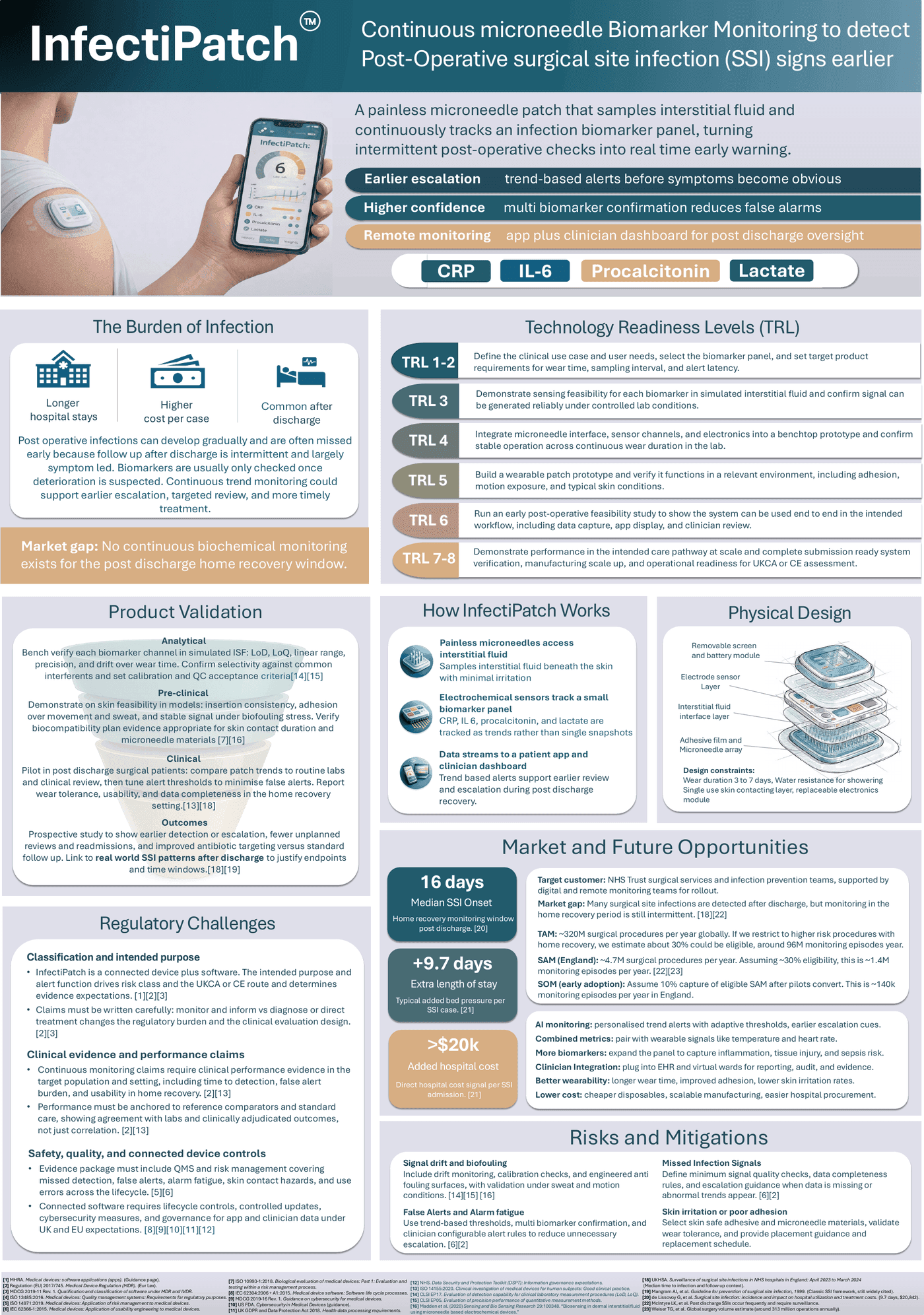
Surgical site infections mostly emerge after the patient has gone home. Median onset is around 16 days, well past the point where anyone is monitoring closely. Follow-up in that window is intermittent and symptom-led, and biomarkers are usually only checked once deterioration is already suspected.
The cost of finding out late is measurable: roughly 9.7 additional bed days and over 20,000 dollars in added hospital cost per infection episode. The monitoring gap sits exactly over the highest-risk period.
The concept
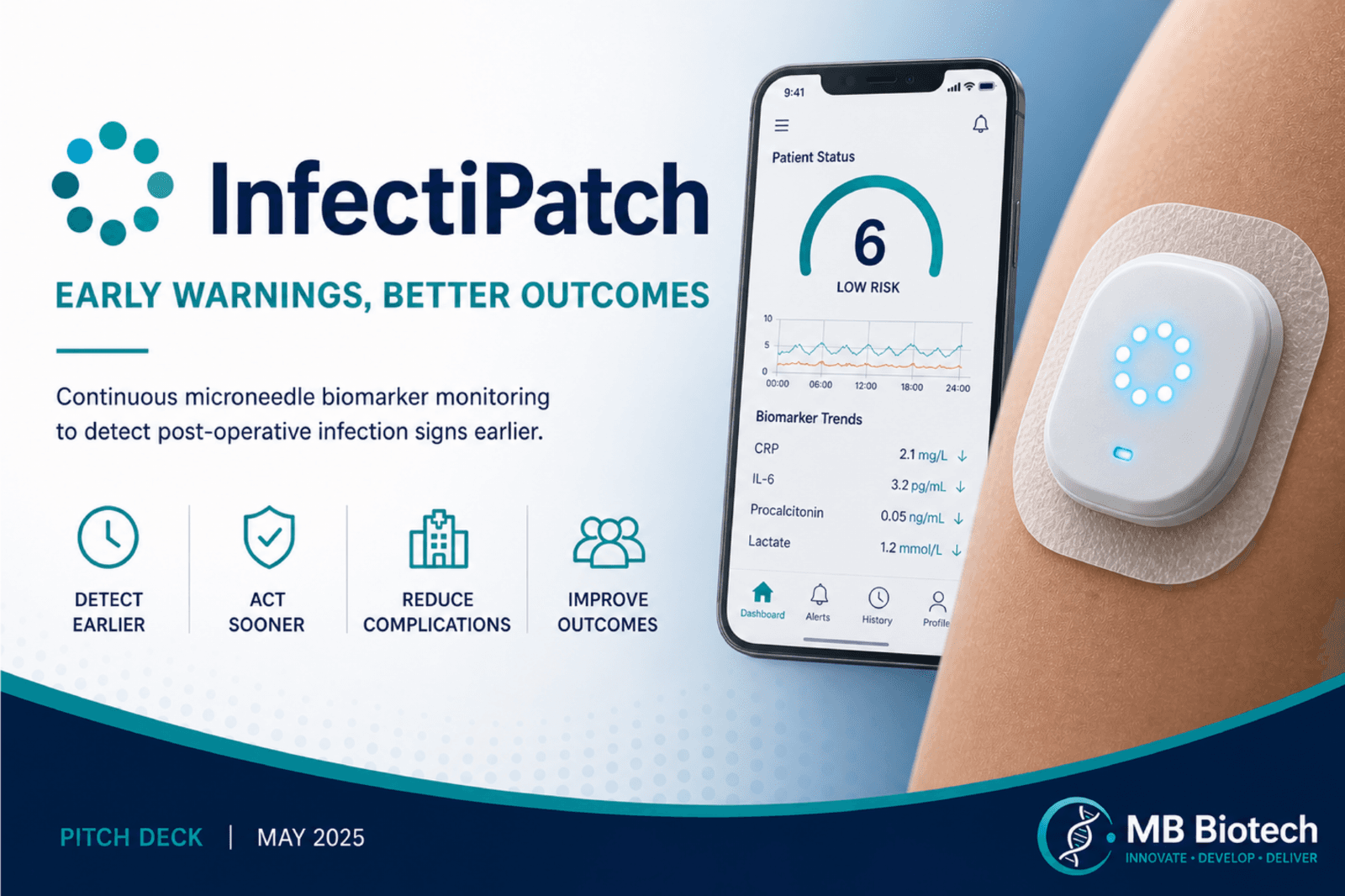
InfectiPatch is a painless microneedle patch that samples interstitial fluid and tracks a small panel of infection biomarkers: CRP, IL-6, procalcitonin and lactate. The point is that it reads them as trends rather than single snapshots, so a rise can be caught before symptoms become obvious.
Data streams to a patient app and a clinician dashboard, with trend-based alerts supporting earlier review. Using several biomarkers together rather than one raises confidence and reduces false alarms.
The physical design is constrained by what patients will actually tolerate: three to seven days of wear, water resistance for showering, a single-use skin-contacting layer and a replaceable electronics module.
Evidence and development plan
The development path is mapped across technology readiness levels one to eight, from defining the clinical use case and biomarker panel through to a submission-ready system verification package.
Analytical work bench-verifies each biomarker channel in simulated interstitial fluid: limits of detection and quantification, linear range, precision and drift over wear time, and selectivity against common interferents. Preclinical work covers insertion consistency, adhesion under movement and sweat, stable signal under biofouling stress, and biocompatibility planning appropriate to skin contact duration and microneedle materials.
The clinical pilot compares patch trends against routine labs and clinical review in post-discharge surgical patients, then tunes alert thresholds to minimise false alerts. The outcome study would need to show earlier detection or escalation, fewer unplanned reviews and readmissions, and better antibiotic targeting against standard follow-up.
Competition and IP
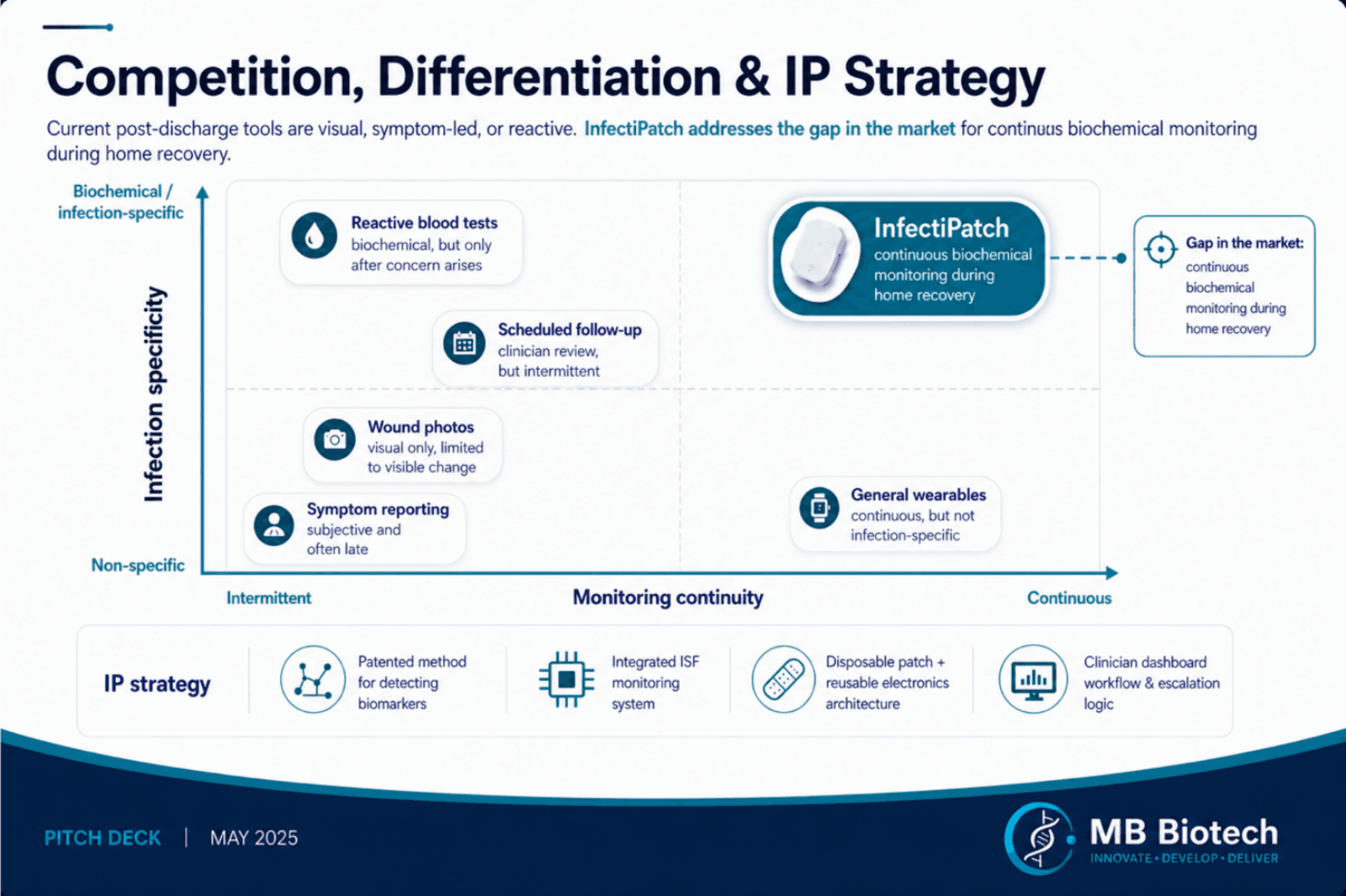
Existing post-discharge tools are visual, symptom-led or reactive. Plotting the landscape on infection specificity against monitoring continuity makes the gap explicit: reactive blood tests are biochemical but only run once concern arises, scheduled follow-up is clinician-led but intermittent, wound photos are visual only, and general wearables are continuous but not infection-specific.
The defensible position is the empty quadrant: continuous biochemical monitoring during home recovery. The IP strategy covers the method for detecting the biomarkers, the integrated interstitial fluid monitoring system, the disposable patch plus reusable electronics architecture, and the dashboard workflow and escalation logic.
Market and route to market
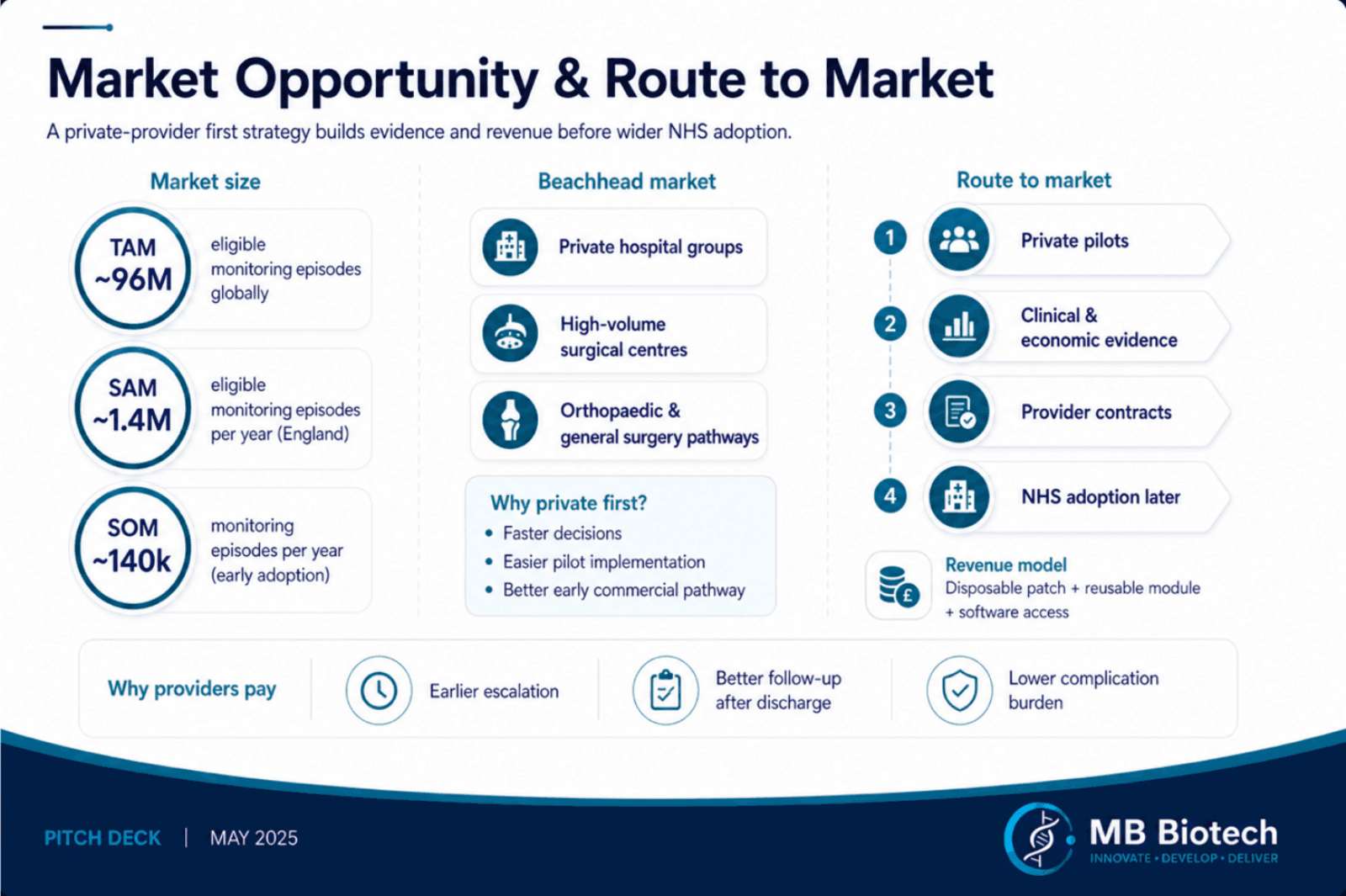
Sizing runs bottom-up from surgical volumes. The total addressable market is roughly 96 million eligible monitoring episodes globally. Serviceable market in England is around 1.4 million episodes per year, and an early-adoption obtainable share is around 140,000 episodes per year.
The strategy is private providers first: private hospital groups, high-volume surgical centres, and orthopaedic and general surgery pathways. Private providers make faster decisions and make pilots easier to run, which builds the clinical and economic evidence needed for provider contracts and eventual NHS adoption.
Commercial model and funding
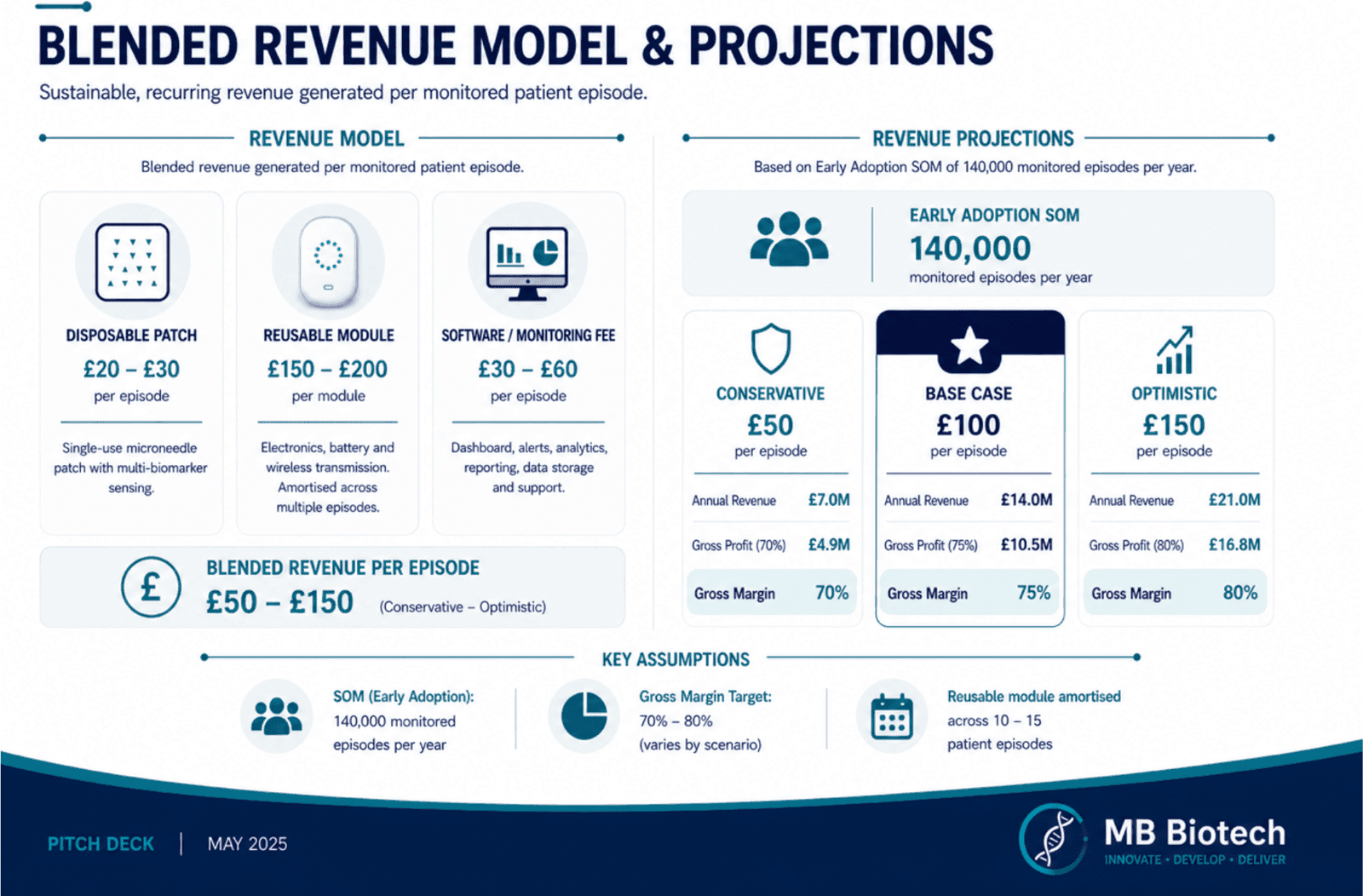
Revenue is blended per monitored episode: a single-use patch at 20 to 30 pounds, a reusable electronics module at 150 to 200 pounds amortised across 10 to 15 episodes, and a software and monitoring fee of 30 to 60 pounds. That gives 50 to 150 pounds per episode depending on scenario.
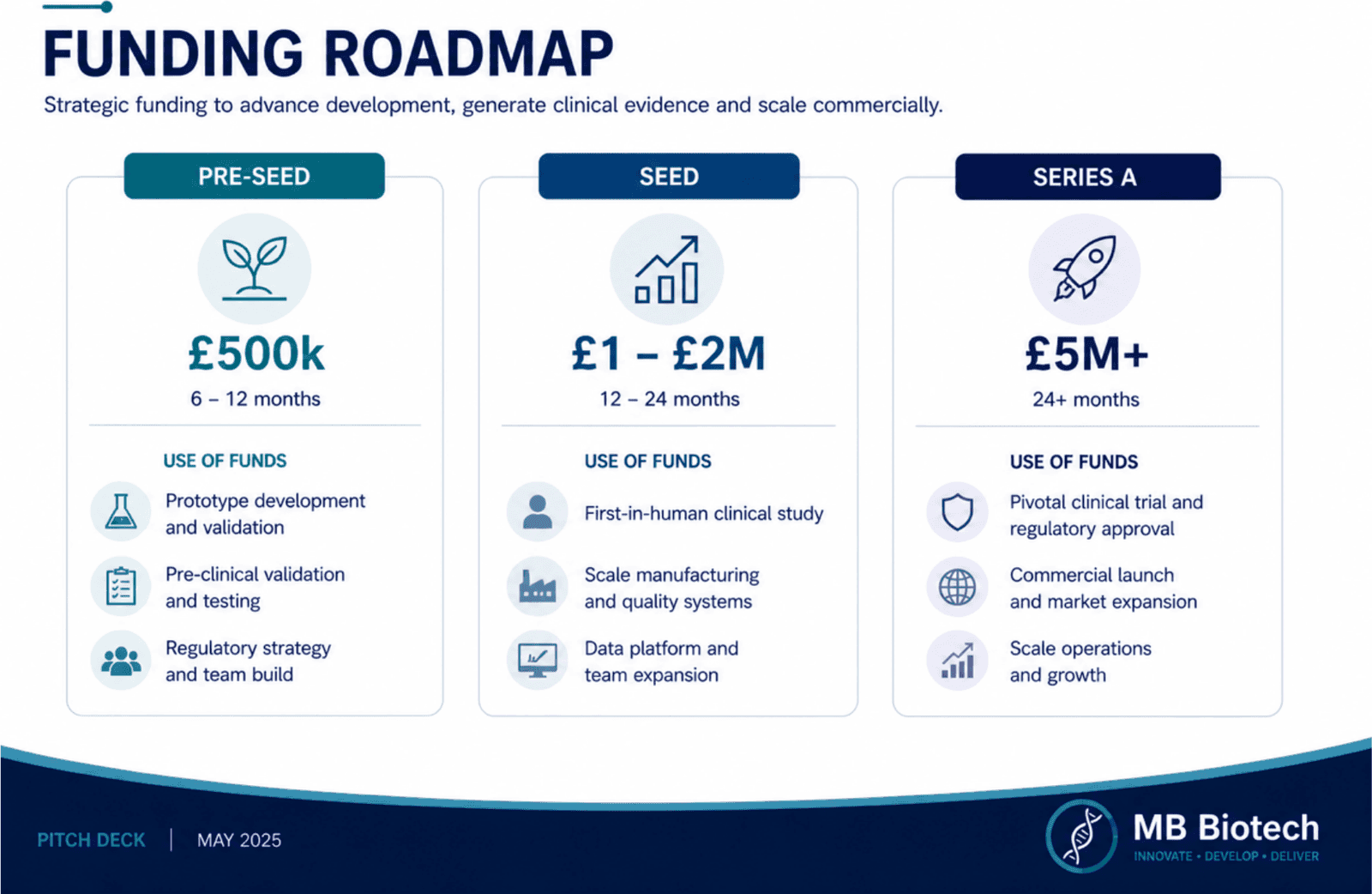
At the early-adoption volume of 140,000 episodes and a base case of 100 pounds per episode, that is around 14 million pounds of annual revenue at a 75 percent gross margin. The funding path is 500,000 pounds pre-seed over 6 to 12 months for prototype development and regulatory strategy, 1 to 2 million seed over 12 to 24 months for a first-in-human study and manufacturing scale-up, and 5 million or more at Series A for the pivotal trial and commercial launch.
Regulatory position
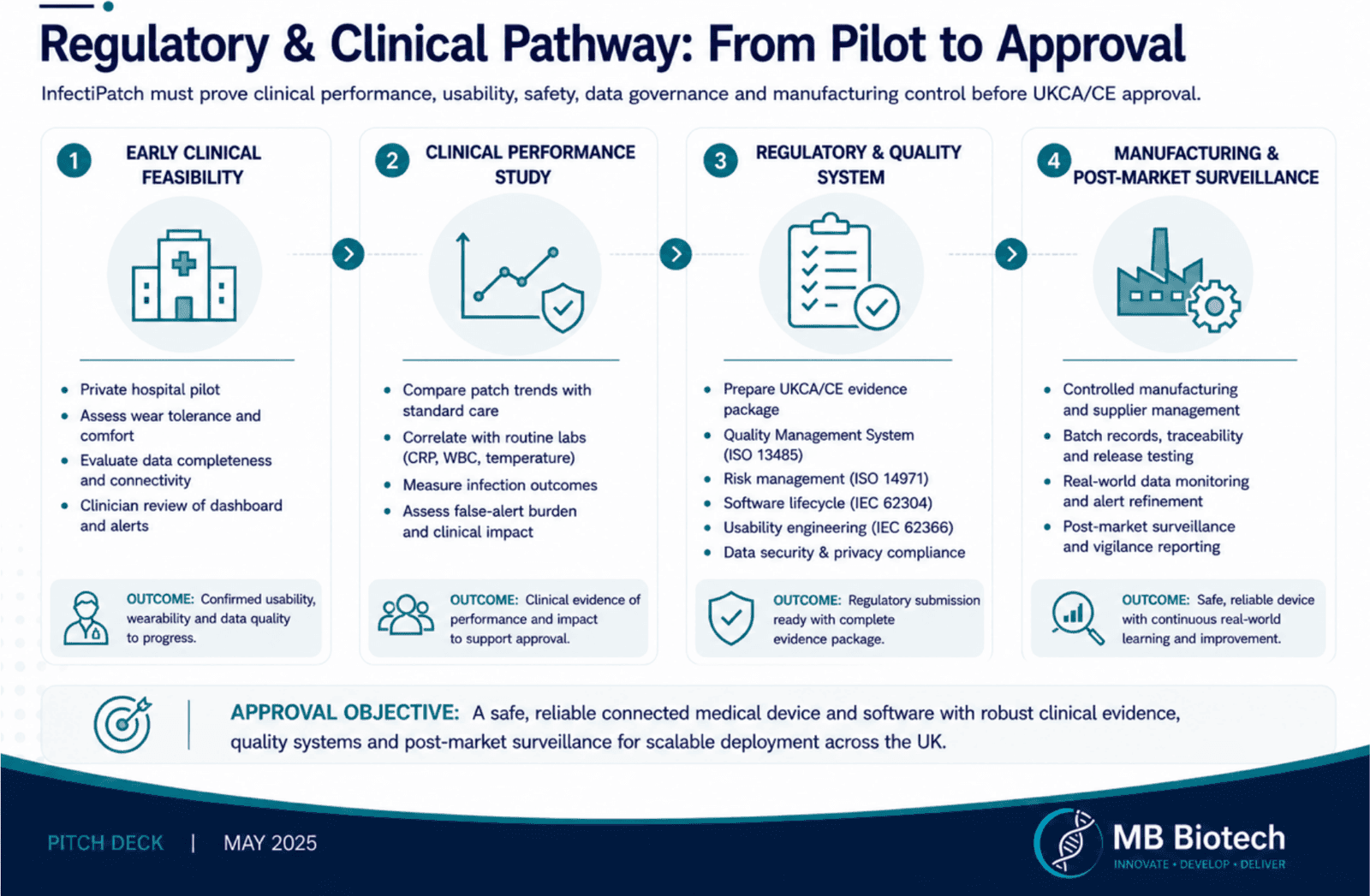
InfectiPatch is a connected device plus software, so the intended purpose and the alert function drive the risk class, the UKCA or CE route and the evidence expectations. Claims have to be written carefully: monitor and inform is a different regulatory burden from diagnose or direct treatment.
The evidence package spans a quality management system and risk management under ISO 13485 and ISO 14971, software lifecycle controls under IEC 62304, usability engineering under IEC 62366, and post-market surveillance. Risks are stated with mitigations: signal drift and biofouling, false alerts and alarm fatigue, missed infection signals, and skin irritation or poor adhesion.
Next step
Get in touch.
Want to talk about a role, a project or any of the work here? Get in touch and I will reply within a working day.
Available from September 2026 for full-time roles and selected freelance projects.