Clinical AI concept
2026WaitWise
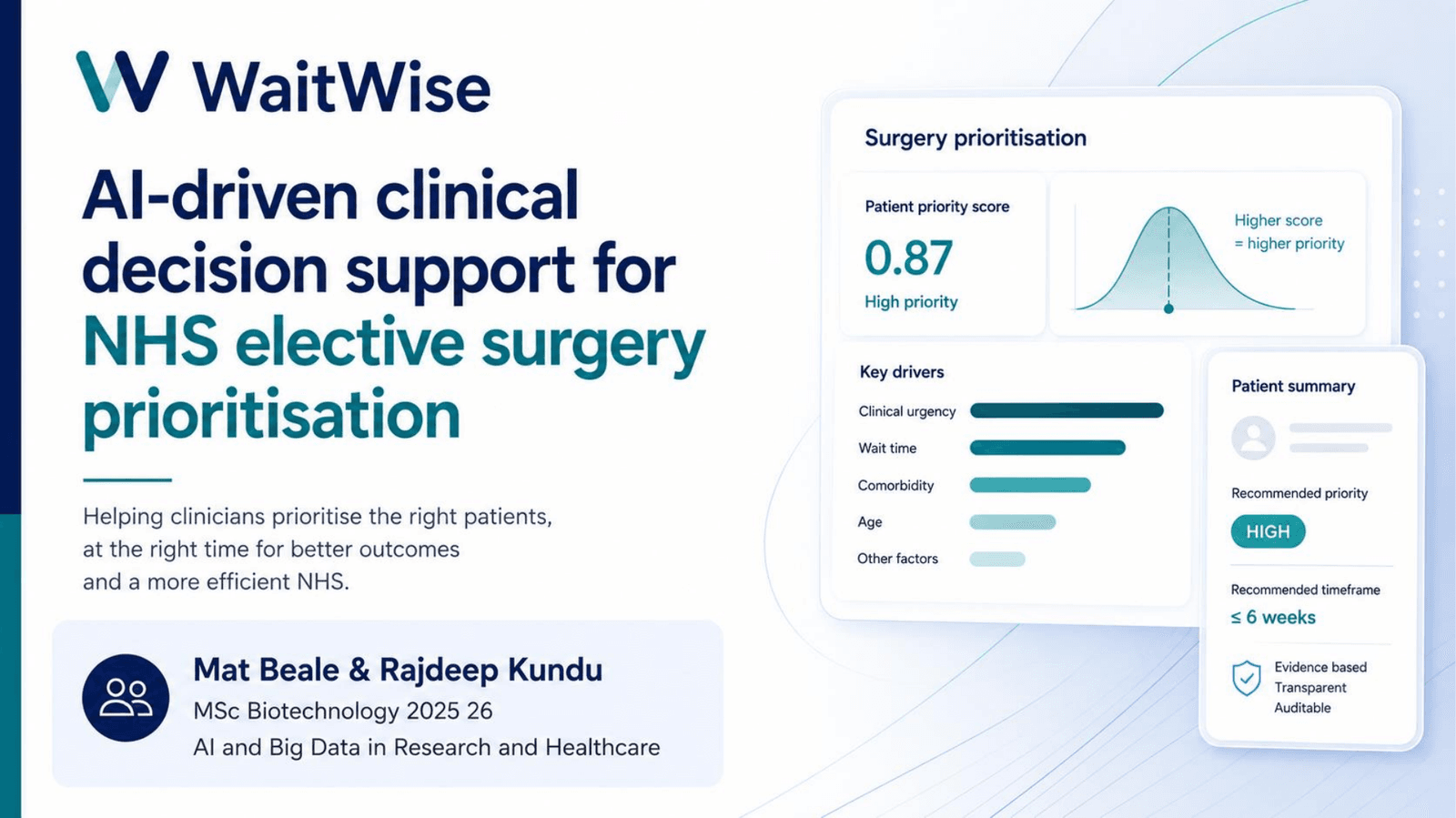
An AI clinical decision support concept for NHS elective surgery prioritisation, designed with Rajdeep Kundu during the MSc: multimodal machine learning with explainability, governance and a phased route into the NHS.
The problem
Over seven million patients sit on NHS England's elective waiting list, and a substantial proportion breach the 18-week referral to treatment standard. Priority is set from referral urgency and clinician judgement at the point of listing.
That assessment is static. It does not update as a patient deteriorates during a wait that may run for a year, even though comorbidities and socioeconomic disadvantage measurably increase post-operative risk. Short-term capacity is fixed: theatres, beds and staff cannot be conjured. The question is therefore not how to do more operations, but how to make sure the right patients are seen first.
Why machine learning, and why not the alternatives
Elective prioritisation needs continuous re-ranking across a large population using both structured records and free text. We assessed the alternatives on that basis rather than assuming ML.
Established clinical scores such as POSSUM and NSQIP are calculated once and not updated. Rule-based triage does not scale and cannot use free-text notes. Manual multidisciplinary review is impossible at seven million patients. Machine learning is the only approach that handles continuous re-ranking with multimodal data, but only if it is explainable, auditable and governed. Those conditions shaped every subsequent decision.
The data, and what makes it hard
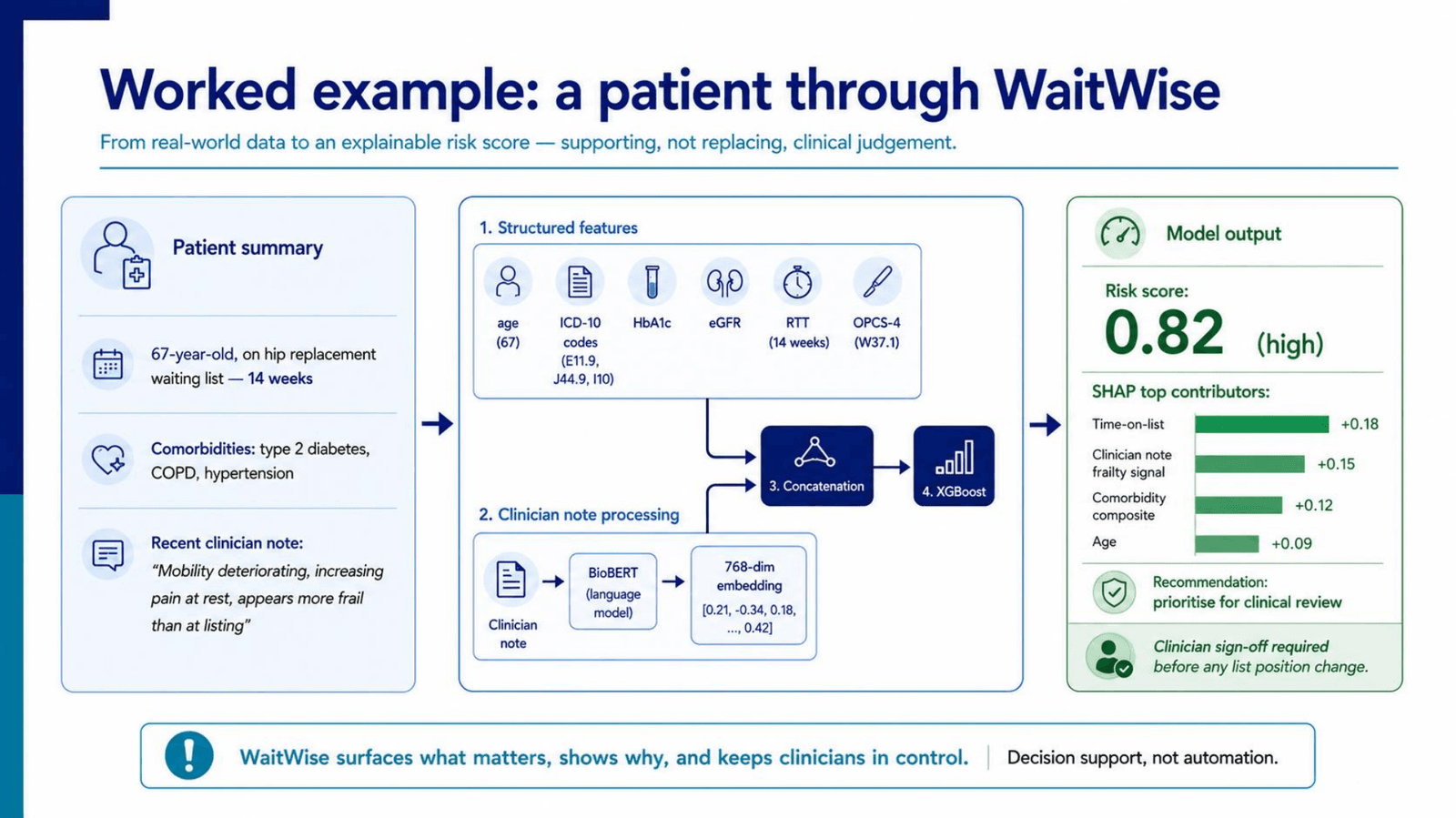
Structured inputs are EHR fields, ICD-10 comorbidity codes, blood panels, referral to treatment times and OPCS-4 procedure codes. Unstructured input is the free-text clinician note.
Each real-world data problem was paired with a specific mitigation. Data fragmented across trusts is handled with normalisation and encoding. Missing or outdated records on long waits are handled with time-on-list decay features. Sparse rare comorbidities are handled with a composite comorbidity score. Historical decisions that may encode bias are flagged for equity audit rather than assumed to be neutral.
Model design
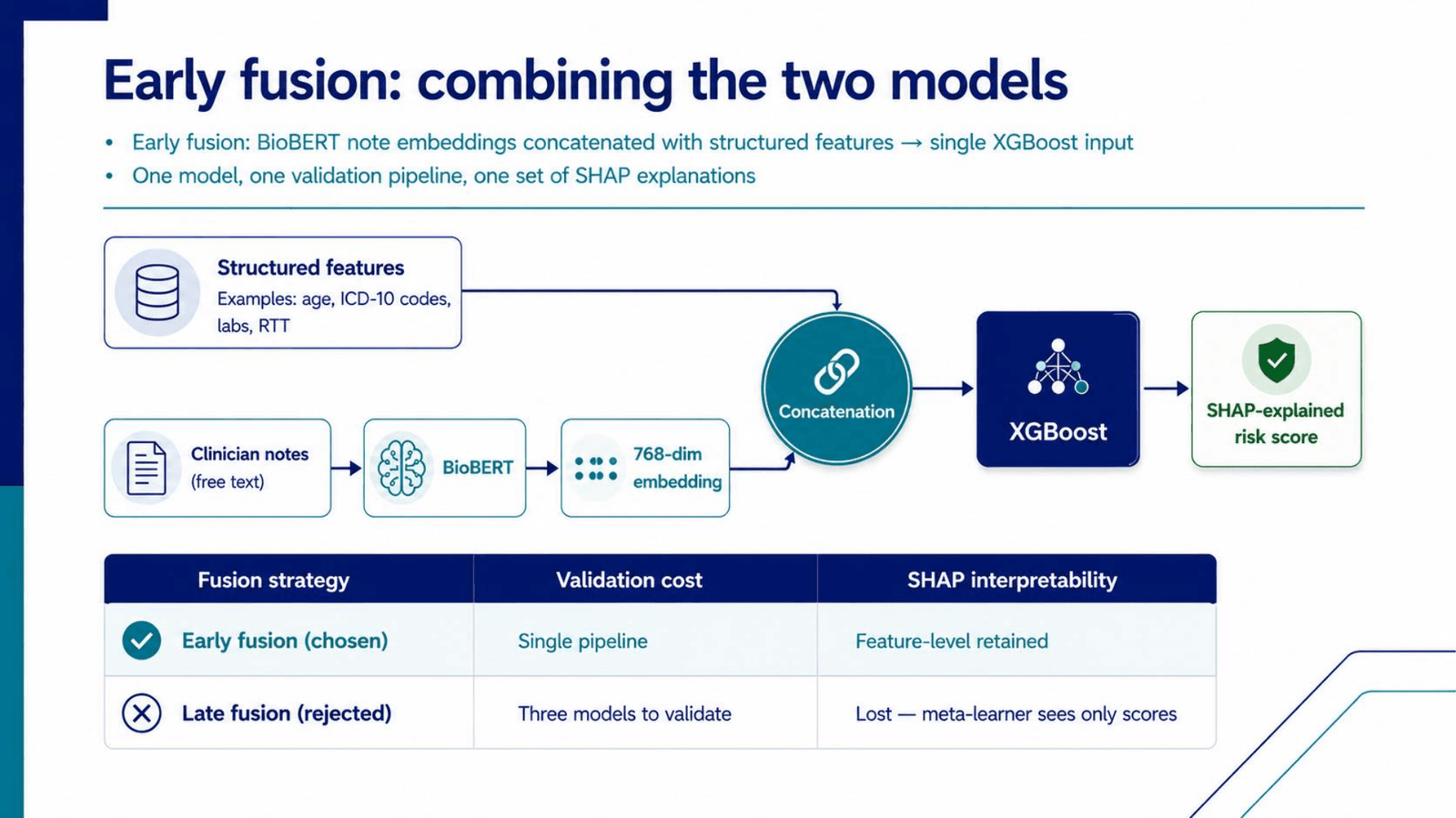
Clinically important information lives in free text. There is no ICD-10 code for a patient struggling to walk or appearing frail. BioBERT, a transformer pre-trained on PubMed biomedical literature, converts each note into roughly a 768-dimensional embedding. ClinicalBERT, trained on MIMIC clinical notes, is a substitute if NHS clinician shorthand turns out to read more like clinical notes than published literature.
XGBoost handles the structured data. It was chosen on explainability, governance and regulatory precedent rather than raw performance. Logistic regression misses non-linear comorbidity interactions. End-to-end deep learning is harder to govern and explain. LightGBM and CatBoost perform comparably but have less mature SHAP tooling and less regulatory precedent. SHAP shows which features drove each individual prediction, which is what makes the output auditable by a clinician or a regulator.
The two are combined by early fusion: note embeddings concatenated with structured features into a single model. That leaves one validation pipeline and retains feature-level SHAP. Late fusion was rejected because it means validating three models and the meta-learner only sees scores, losing the feature-level explanation that the whole design depends on.
Keeping it trustworthy
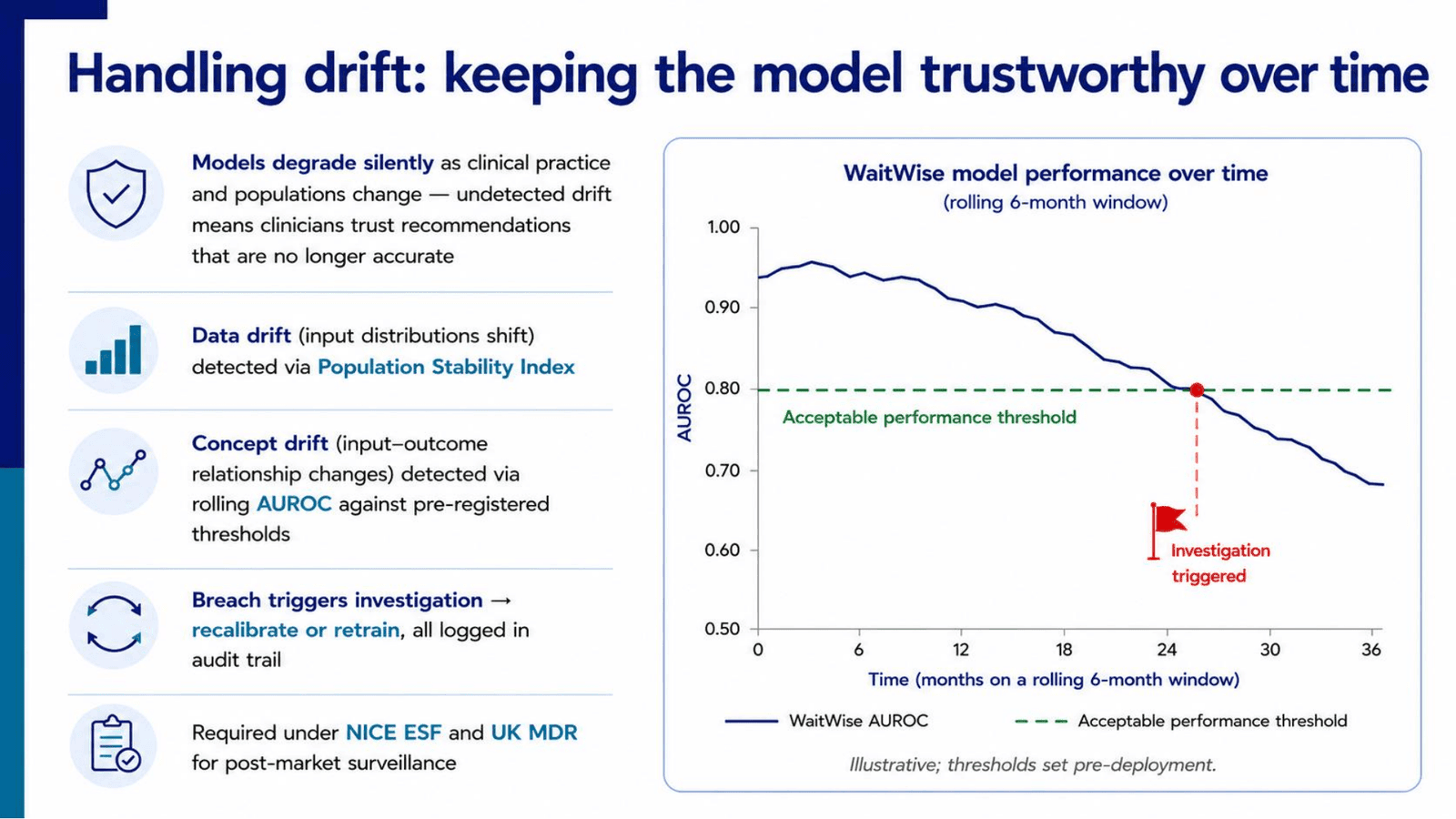
Models degrade silently as clinical practice and populations change, and undetected drift means clinicians trusting recommendations that are no longer accurate. Data drift is detected with the Population Stability Index and concept drift with rolling AUROC against pre-registered thresholds. A breach triggers investigation, then recalibration or retraining, all logged in an audit trail.
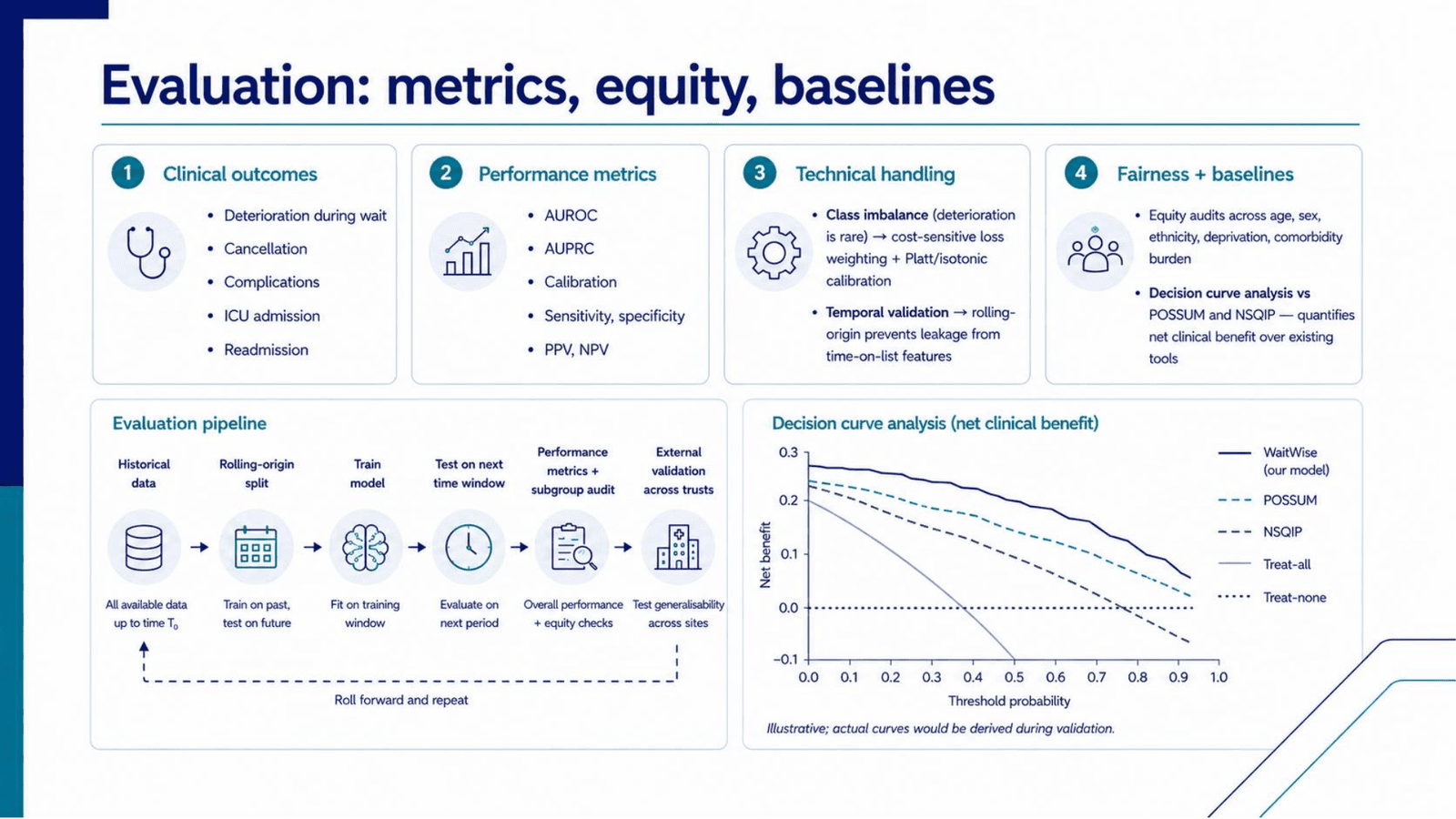
Evaluation runs against clinical outcomes that matter: deterioration during the wait, cancellation, complications, ICU admission and readmission. Metrics are AUROC, AUPRC, calibration, sensitivity, specificity, PPV and NPV. Deterioration is rare, so class imbalance is handled with cost-sensitive loss weighting and Platt or isotonic calibration. Temporal validation uses a rolling-origin split, which prevents leakage from the time-on-list features.
Fairness is treated as a measurement, not an intention: equity audits across age, sex, ethnicity, deprivation and comorbidity burden. Decision curve analysis against POSSUM and NSQIP quantifies whether the model delivers net clinical benefit over the tools already in use, which is the comparison that actually justifies adoption.
Deployment, regulation and risk
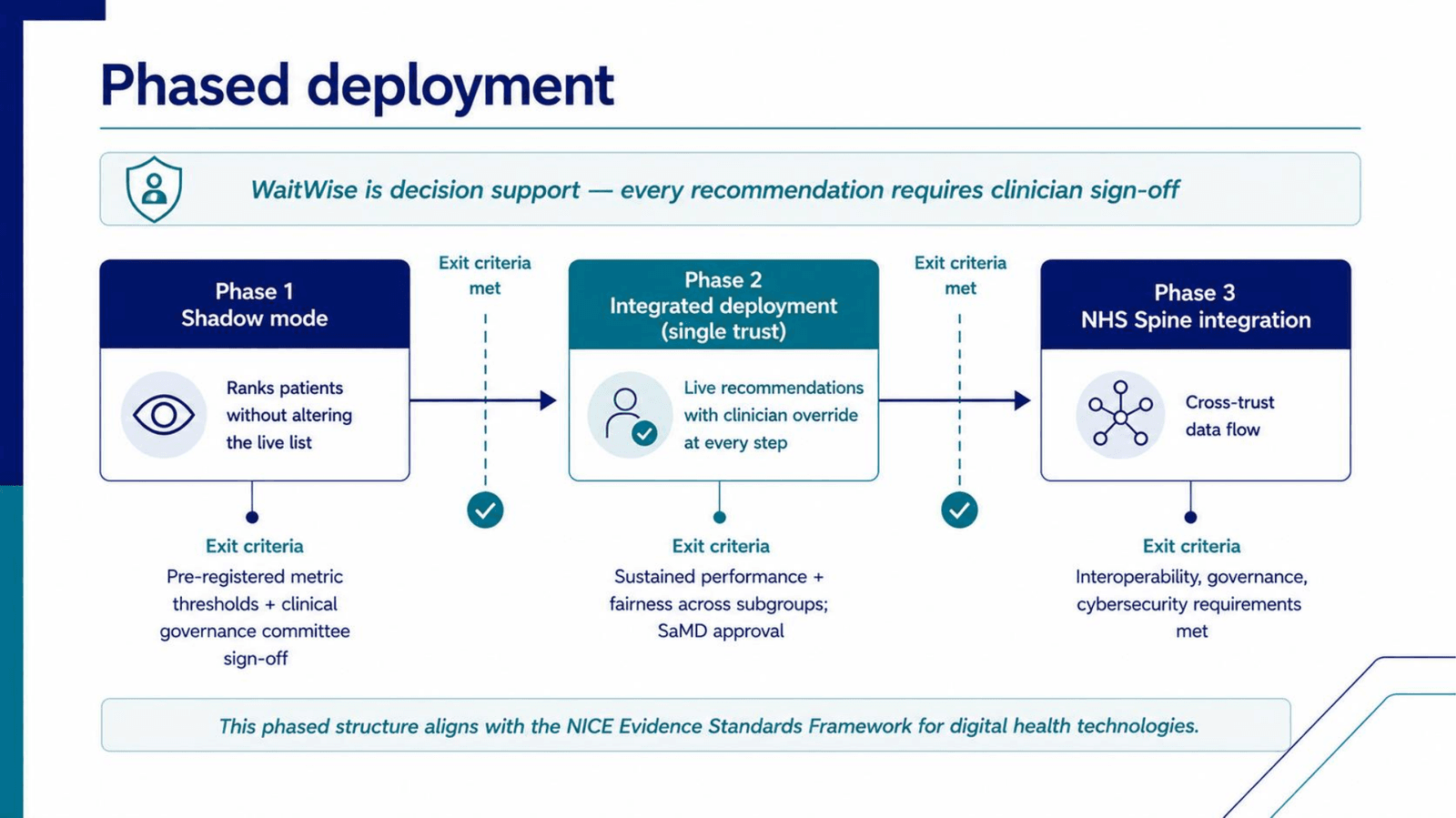
Deployment is phased with explicit exit criteria at each step. Phase one runs in shadow mode, ranking patients without altering the live list, and exits on pre-registered metric thresholds plus clinical governance committee sign-off. Phase two is integrated deployment in a single trust with clinician override at every step, exiting on sustained performance, fairness across subgroups and software as a medical device approval. Phase three adds NHS Spine integration for cross-trust data flow once interoperability, governance and cybersecurity requirements are met.
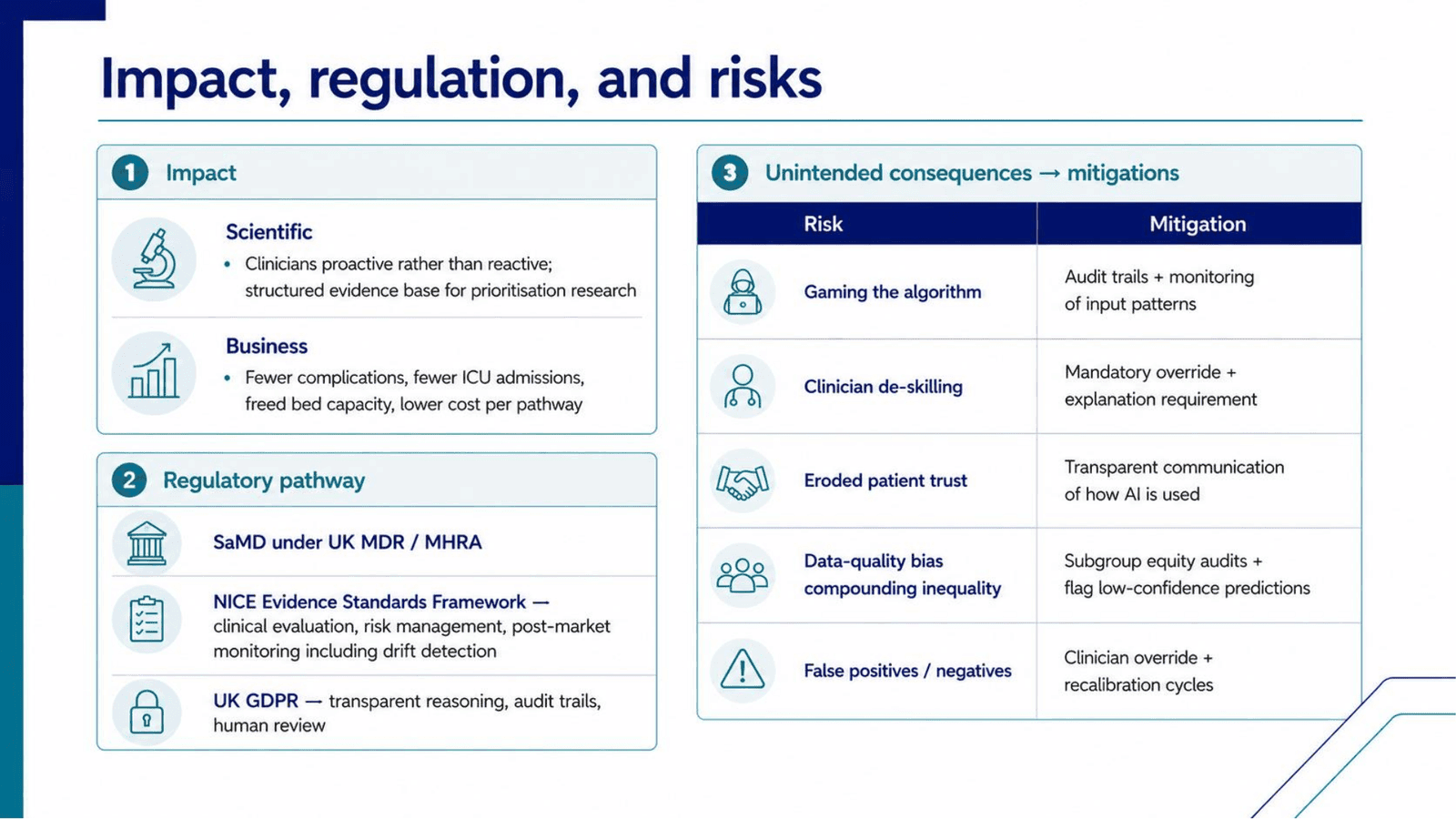
The product would be regulated as software as a medical device under UK MDR and the MHRA, evidenced against the NICE Evidence Standards Framework, and operated under UK GDPR with transparent reasoning, audit trails and human review.
The risk analysis covers the unglamorous failure modes: gaming the algorithm, clinician de-skilling, eroded patient trust, data-quality bias compounding existing inequality, and false positives and negatives. Each has a stated mitigation, from mandatory override and explanation requirements through to subgroup equity audits and flagging low-confidence predictions.
Credit
Designed and presented with Rajdeep Kundu for the MSc module AI and Big Data in Research and Healthcare, University of Reading.
Next step
Get in touch.
Want to talk about a role, a project or any of the work here? Get in touch and I will reply within a working day.
Available from September 2026 for full-time roles and selected freelance projects.