01 · Chromatin
A gene, packed into chromatin
Most cells in your body hold two copies of your genome, one from each parent, each about 3.1 billion base pairs long. That DNA is not left loose: it is wound around histone proteins into nucleosomes, which compact it and limit which parts the cell's machinery can reach.
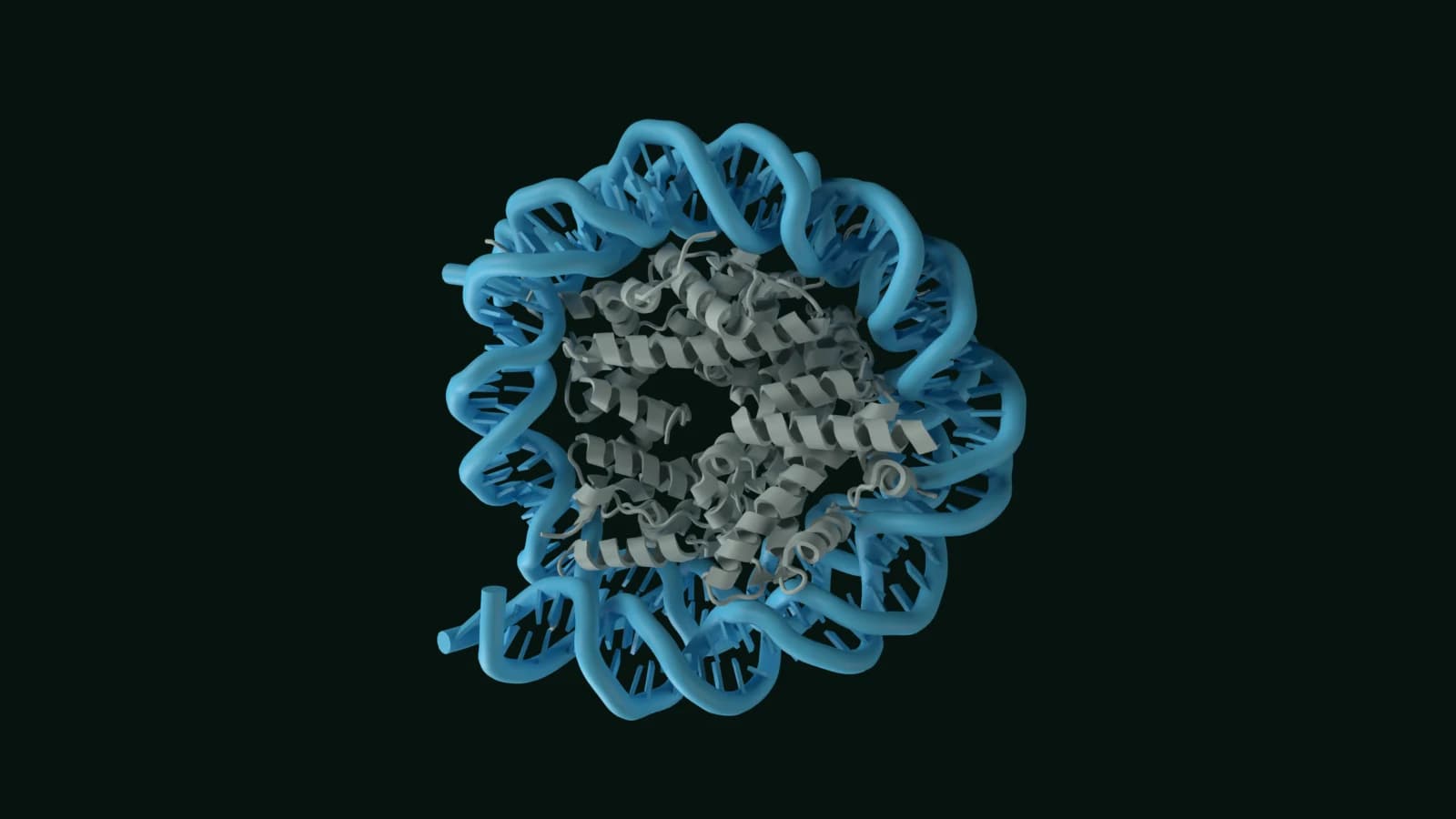
This human nucleosome was solved by X-ray crystallography. Its 146 base pairs of DNA wrap about 1.65 times (a little under two turns) around a core of eight histones, two each of H2A, H2B, H3 and H4. The grip is a balance: tight enough to keep the DNA packed and protected, loose enough for the enzymes that read genes to get in.
What you are looking at
- The DNA double helix: 146 base pairs wrapped about 1.65 times around the core.
- The eight histones. Their tails reach outwards; much of their length is too disordered to be seen in the crystal.
- Structure
- Human nucleosome core particle. PDB 3AFA (opens the RCSB PDB in a new tab)
- Method
- X-ray crystallography, 2.5 Å, released 2010
- Size
- About 12 nm across at its widest and about 6.5 nm thick.
- Paper
- Tachiwana H, Kagawa W, Osakabe A, et al. (2010). Structural basis of instability of the nucleosome containing a testis-specific histone variant, human H3T. Proc Natl Acad Sci U S A 107:10454-10459. doi:10.1073/pnas.1003064107
- Chromatin12 nm
- Transcription17 nm
- Splicing36 nm
- Export45 nm
- Translation32 nm
- Exit tunnel32 nm
- Folding17 nm
- At work7 nm
Sizes are in nanometres; 1 nm is a millionth of a millimetre. The eight structures come from separate experiments published between 2006 and 2025, so they show the stages of making a protein, not one molecule passing through them. All the proteins are human. The RNA being spliced in step 3 is listed as coming from an adenovirus, and in step 5 the message is synthetic and the tRNAs have a bacterial sequence.